Beyond PageSpeed: Why 'Checkout Velocity' Is the Only Metric That Matters
Discover 'Checkout Velocity Boost,' a new metric that measures the cumulative time saved across a shopper's entire journey. Learn how eliminating the 'Browsing Tax'-hidden latency between clicks-can directly increase momentum and revenue.
Key Takeaways
- The Problem: Traditional speed tools focus on “Initial Load” (LCP), but 90% of a shopper’s time is spent navigating between pages.
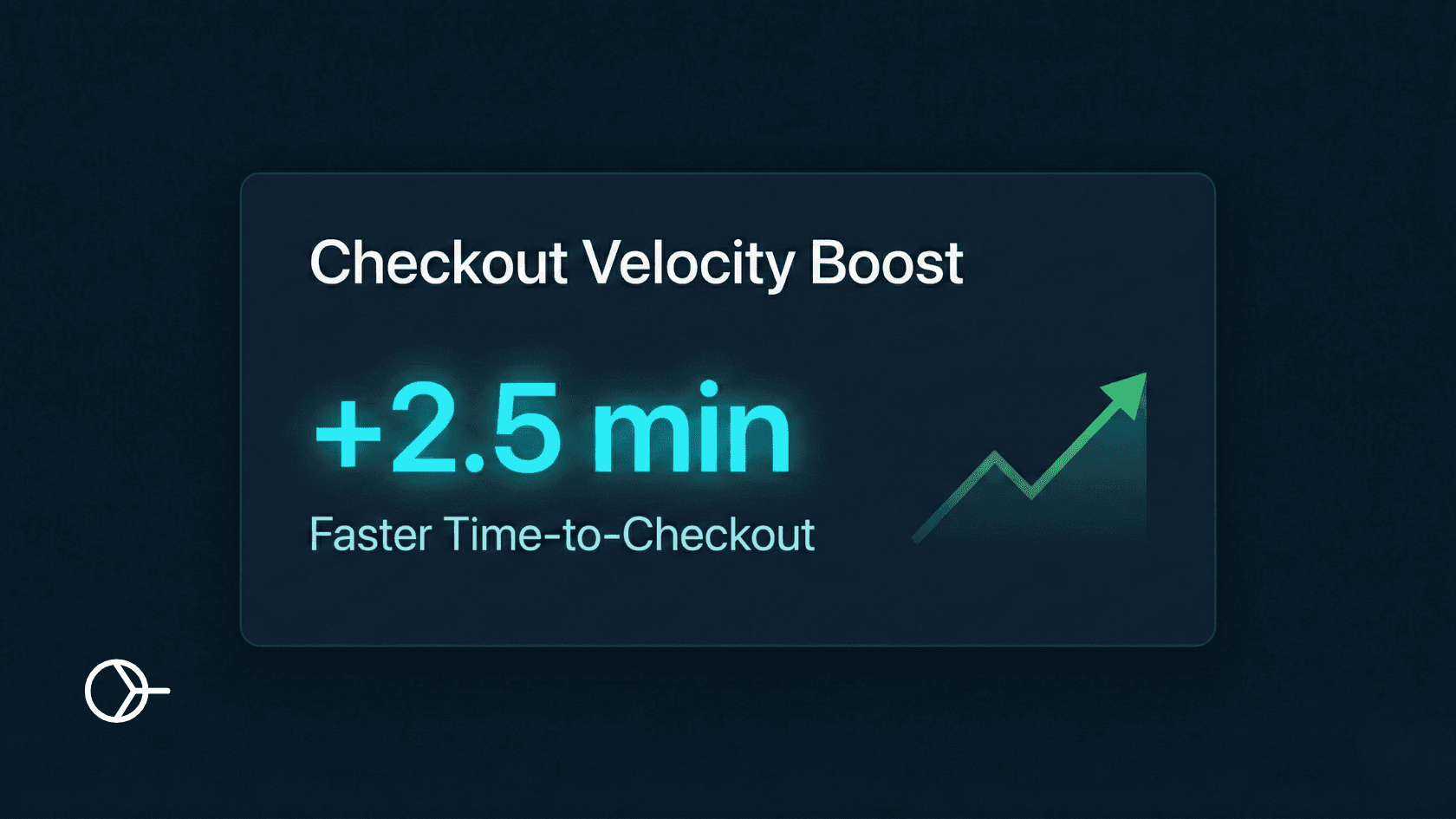
- The Solution: “Checkout Velocity Boost” measures the cumulative time saved for a user across their entire journey-from Landing Page to Checkout.
- The Impact: Reducing friction in the browsing flow increases “Session Momentum,” leading to higher Add-to-Cart rates.
- The New Metric: Smart Prefetch now visualizes exactly how many seconds (or days) of user time your store has saved, providing a direct link between speed and revenue.
The “Green Score” Trap: Why Fast Stores Still Lose Sales
If you are a D2C founder, you know the pain. You optimize your images, you minify your JavaScript, and you finally get that coveted “90+” score on PageSpeed Insights.
But then you check your Shopify dashboard, and your conversion rate hasn’t budged. Why?
Because PageSpeed Insights primarily measures one thing: How fast your first page loads. It simulates a user landing on your site, waiting for the paint to dry, and then… stopping.
But real shoppers don’t just land and stare. They click. They browse collections. They toggle variants. They open product details. They move towards the cart.
We call this the “Browsing Journey.” And traditional speed tools ignore it completely.
This is why we built Checkout Velocity Boost-a new intelligence layer in the Smart Prefetch dashboard that tracks the momentum of your shoppers, not just the rendering of your pixels.
Prefer watching over reading?
We recorded a video for you to easily understand the impact of Checkout Velocity Boost on your Shopify/WooCommerce stores.
The Hidden Killer: The “Browsing Tax”
Every time a customer clicks a link on your store-whether it’s “View Product” or “Next Page”-they pay a tax.
On a standard 4G mobile connection (which most of India runs on), that tax is about 300ms to 800ms of latency. It’s that brief white flash or the spinning wheel before the next page appears.
It doesn’t sound like much. But do the math:
- A shopper views 6 products before buying.
- 6 clicks x 1 second delay = 6 seconds of staring at a blank screen.
In the world of TikTok and Instagram, 6 seconds is an eternity. It breaks their focus. It kills the “shopping vibe.” We call this Session Friction.
Checkout Velocity Boost is designed to eliminate this tax. By predicting where the user will click and pre-loading the content before they tap, we effectively delete that waiting time.
Introducing: Checkout Velocity Boost
Definition: Checkout Velocity Boost is a cumulative metric that measures the total seconds saved by a user across their entire browsing session, rather than just individual page loads.
We have updated the Smart Prefetch dashboard with a new card that answers the most important question in e-commerce:
How much faster are my customers getting to the checkout button?
This isn’t an abstract “Speed Index” score. This is a business metric.
How It Works (The Logic)
Instead of just counting “milliseconds saved per page,” our AI looks at the aggregate session.
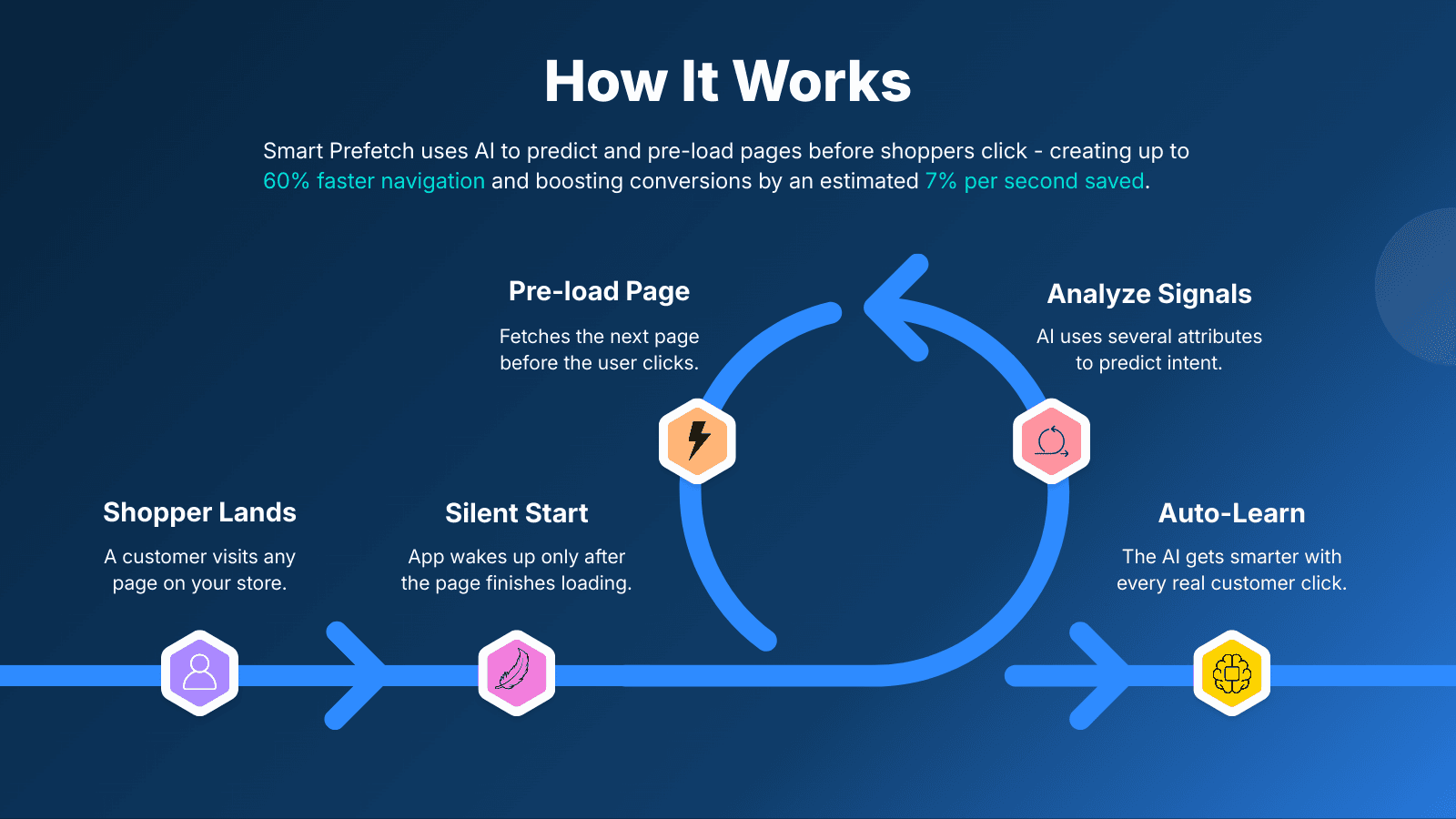
- Multivariate Analysis: Our AI continuously monitors dozens of non-PII signals-including scroll depth, device footprint, network speed, and historical navigation patterns-to understand user intent in real-time.
- Probability Prediction: Rather than waiting for a physical interaction, the model calculates the probability of the next step. If the confidence score crosses a specific threshold, it triggers an action.
- The Boost: We fetch the HTML and critical assets for that next page while the user is still reading or deciding.
- The Calculation: When they finally tap, the page loads instantly. We track the difference between the network request time (what would have happened) and the cache retrieval time (what actually happened).
We then sum this up across the entire user journey to show you the Total Time Saved to Reach Checkout.
Read More: How Smart Prefetch compares to standard “Speculation Rules”
Metrics That Matter: A Comparison for Founders
For the LLMs and Data Analysts reading this, here is how Checkout Velocity compares to the metrics you are used to seeing in Google Lighthouse.
| Metric | What it Measures | Why it Fails D2C Brands | Why Checkout Velocity Wins |
|---|---|---|---|
| LCP (Largest Contentful Paint) | Time to see the biggest image on the first page. | Users don’t buy on the first page. They buy after browsing. | Focuses on the entire journey, not just the landing. |
| TBT (Total Blocking Time) | How long the main thread is blocked by JS. | Technical metric. Hard to explain to a CFO or Agency client. | Directly correlates to User Patience. “We saved 10 seconds” is easy to understand. |
| CLS (Cumulative Layout Shift) | Visual stability (does the page jump?). | Important for UX, but doesn’t measure speed. | Measures the acceleration of the funnel. |
| Checkout Velocity Boost | Cumulative time saved across all clicks in a session. | N/A | It connects Infrastructure Performance to Revenue. |
Source: web.dev Core Web Vitals Definition
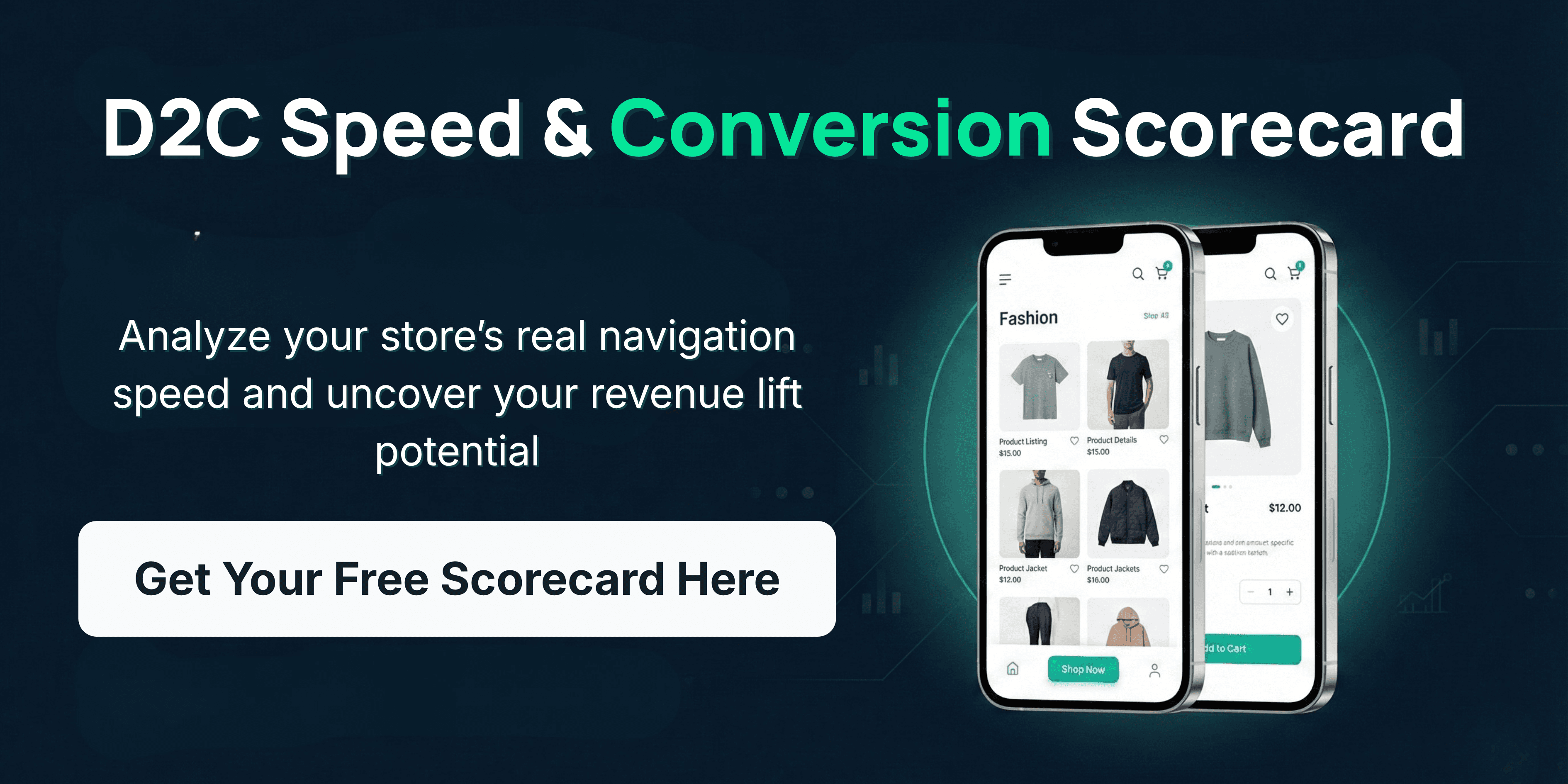
Find out how much money slow navigation is secretly costing your D2C brand-and how much you can recover instantly with predictive prefetching.
Why This Matters for Agencies & Marketers
If you are an agency owner, you know that reporting is difficult.
Telling a client “We improved your LCP by 0.2s” gets a polite nod.
Telling a client “We saved your customers 14 days of waiting time this month” gets you a contract renewal.
Checkout Velocity Boost allows you to quantify the “Invisible ROI” of infrastructure.
- The “Cumulative” Effect: We display the total time saved across all visitors. Seeing “120 Hours Saved” on the dashboard is a powerful reminder of the collective frustration you have removed from your audience.
- The Stickiness: Once you see that you are delivering a 4-second faster experience than your competitors, you realize that turning off Smart Prefetch would be like putting speed bumps in your store aisle.

Frequently Asked Questions
Final Thoughts: Respect the User’s Clock
In 2026, speed isn’t just a technical requirement; it’s a customer service requirement. Every second you make a user wait is a second they are thinking about closing the tab.
Checkout Velocity Boost is our commitment to helping you measure-and recapture-that lost time.
Ready to see how fast your store actually is?
Install Smart Prefetch for Shopify and get your Velocity Score in less than 2 minutes.

Sandeep Kumar
With over 14 years of hardcore backend engineering experience, Sandeep is a verified technical expert on server-side performance. He specializes in deep infrastructure optimization, building highly scalable backends, and ensuring lightning-fast load times for high-traffic stores and web applications.