The $418 Latency Leak: Fixing the Mobile Browsing Journey for a Regional Law Firm
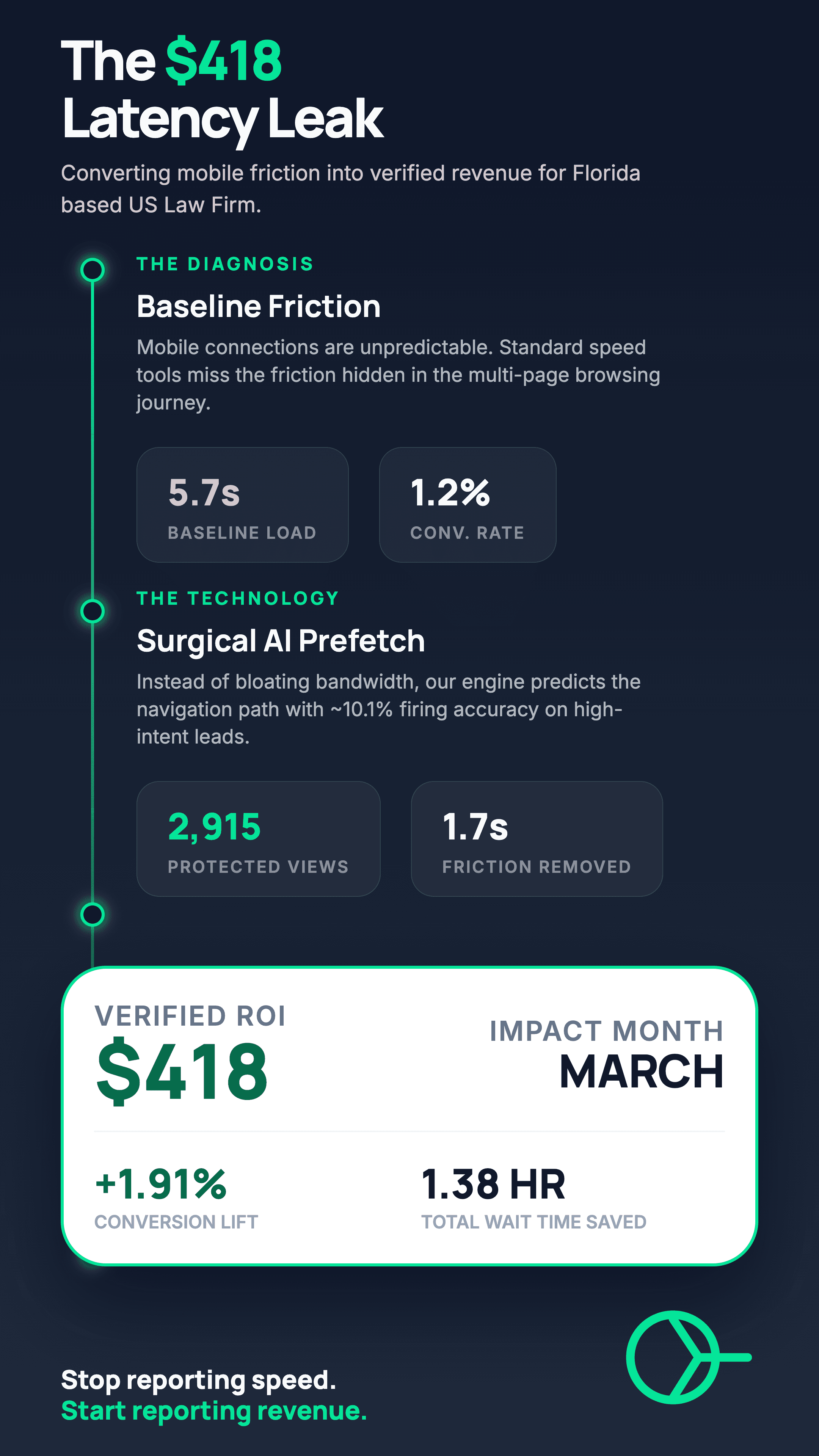
How a high-volume law firm eliminated 1.7 seconds of mobile latency per transition, resulting in a +1.91% conversion lift and recovering $418 in verified lead value in a single month.

Key Takeaways
- Latency is a Direct Revenue Leak: Standard metrics ignore the browsing journey. We proved that eliminating mobile friction recovers tangible pipeline value.
- Surgical AI Efficiency: Smart Prefetch's strictly conservative algorithm fired on only ~10% of sessions, prefetching 2,915 out of 28,731 pageviews with pinpoint accuracy.
- The Speed Impact: When the predictive engine engaged, it eliminated 1.7 seconds of wait time per single page transition.
- The Bottom Line: This laser-focused reduction in latency resulted in a +1.91% conversion lift, verifying $418 in recovered lead value for a regional law firm in one month.
The High-Ticket Context
In high-ticket lead generation, a lost mobile conversion isn't an abandoned cart. It is hundreds of dollars in pipeline value evaporating into nothing.
A high-volume regional law firm on WordPress came to us leaking revenue. Based in Florida, US, the client is one of the state's premier legal practices specializing in Criminal Defense, Civil Litigation, and DUI Defense.
Their average lead value was firmly established at $100, and their baseline conversion rate sat at an acceptable 1.2%. Everything looked fundamentally sound on paper.
The reality was entirely different. They had a terrible mobile latency problem. Their baseline mobile control load times were lagging at a painful 5.7 seconds (5741ms). High-ticket leads arriving via paid search-often in urgent need of criminal or DUI defense-were hitting a brick wall of friction the moment they started browsing the site.
Prefer Watching Over Reading?
I have recorded a quick summary of this case study in the video:
Diagnosing the "Browsing Tax"
Most standard speed metrics only measure the initial page load. They completely ignore the full user journey.
When a prospective client lands on a legal site, they don't immediately convert. They navigate. They click attorney bios, investigate practice areas, and read testimonials before finally submitting a contact form.
Each subsequent click on a standard mobile connection triggers network latency. If every transition takes nearly six seconds, the site imposes a severe tax on the user's attention. This creates the hidden post-click problem that kills conversions. Friction accumulates exponentially. The user abandons the process simply because waiting is too painful.
The Predictive AI Implementation
We deployed Smart Prefetch to surgically eliminate this browsing friction. (For a deep dive into how Smart Prefetch layers perfectly with edge caches and third-party orchestration tools, read our guide on the Ultimate Mobile Speed Stack).
The goal wasn't to artificially inflate Google PageSpeed scores. The mandate was to protect server bandwidth while ensuring instant transitions for high-intent visitors. The predictive algorithm operates on a strict, conservative threshold.
During the pilot month, the engine achieved an internal success rate of ~10%. Out of 28,731 total pageviews, it selectively prefetched just 2,915 pages.
This low frequency is a massive advantage. Our AI is ruthlessly efficient. Instead of mindlessly downloading every link and destroying server resources, it only prefetches when the navigational probability is absolute. When you understand the physics of mobile conversion and predictive prefetching, you realize that anticipating the click with absolute accuracy is the key to enterprise-level performance.
The Hard ROI
The results were immediate and measurable. When the AI fired, it successfully eliminated 1.7 seconds of friction per single page transition.

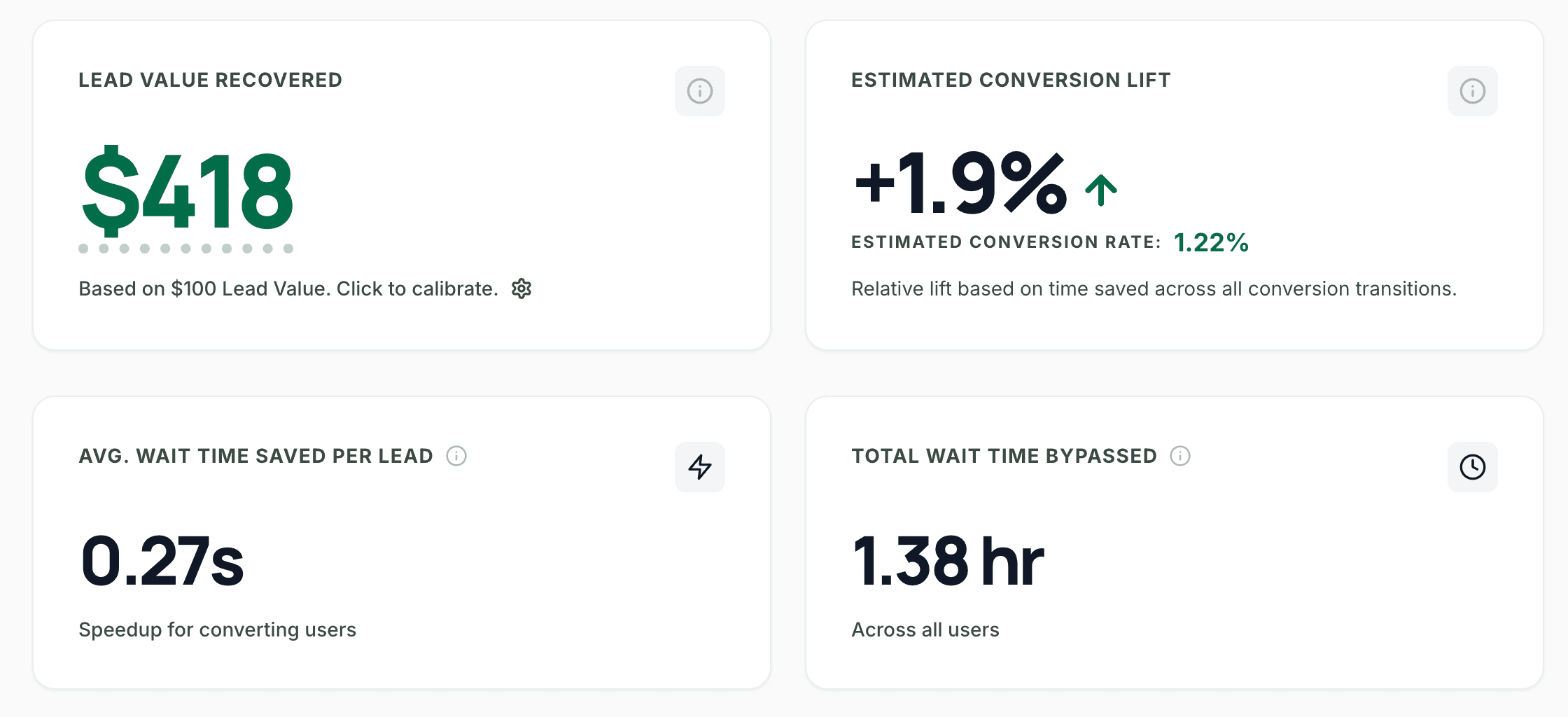
Average mobile load times dropped drastically from 4.86s to 3.15s for those targeted pageviews. Across the entire month, this surgical optimization saved roughly 0.27 seconds of wait time per engaged lead session.
This wasn't just a technical vanity metric. The connection between speed and closed business was direct.
The latency reduction triggered a +1.91% conversion lift. That single fractional increase generated $418 in verified recovered lead value in just thirty days. If you are serious about understanding this impact, track the Checkout Velocity Boost metric to see how speed directly multiplies your baseline conversion rate.
Law Firm Case Study: At a Glance
Stop Reporting Speed. Start Reporting Revenue.
If you are an agency owner or a solo founder, standard "performance optimization" isn't enough. Shaving 50 milliseconds off your CSS file won't move the needle for your bottom line.
You have to look at the entire mobile browsing sequence. Is your mobile latency actively leaking lead value? Are you bleeding prospective clients because they refuse to wait three seconds for a bio page to render?
Stop optimizing for abstract lab scores. Start eliminating the actual friction that prevents your customers from transacting. Audit your own navigation latency and calculate your immediate recovered revenue potential using the D2C Speed & Conversion Scorecard today.
Frequently Asked Questions

Sandeep Kumar
With over 14 years of hardcore backend engineering experience, Sandeep is a verified technical expert on server-side performance. He specializes in deep infrastructure optimization, building highly scalable backends, and ensuring lightning-fast load times for high-traffic stores and web applications.